Coding agents that remember how you work.
Prokop is an open-source agentic coding workspace. Persistent agents keep their own memory, skills, and searchable history across projects, while each project keeps its context separate and inspectable.
the problem
Your coding agent is smart.
Its working environment is still temporary.
Six sessions become six windows.
Parallel work turns into terminal management. The desktop becomes the job.
Every project starts from zero.
Context lives inside one session. Close it and the decisions, fixes, and conventions evaporate.
The new session has never met you.
Re-explain your stack, your conventions, your preferences. Every time. To a capable stranger.
Remote means a chat bridge.
Check in from your phone and you get a stripped-down bot, not your actual workspace.
continuity
Stop briefing a stranger every session.
Your agent's knowledge follows it across projects. Project knowledge stays scoped to the workspace. Both live in plain files you can read and edit.
How you work
Your preferences and reusable ways of working.
“Start code reviews with a short summary. Link the failing test.”
How this project works
This repo's conventions, commands, and decisions.
“Use Bun for this repo. Run the smallest relevant test target first.”
Saved knowledge provides context when the corresponding memory capabilities are enabled.
Find the past decision.
Search previous sessions for the reasoning you need, instead of working it out again.
Reuse the procedure.
Keep repeatable work, such as a release checklist, in a skill the agent can use again.
Preserve useful lessons.
Turn on conversation review to preserve useful knowledge and optionally create or refine skills.
Saved knowledge is yours to read, edit, version, or delete.
Explore memory and skills →the workspace
Run the work, not the windows.
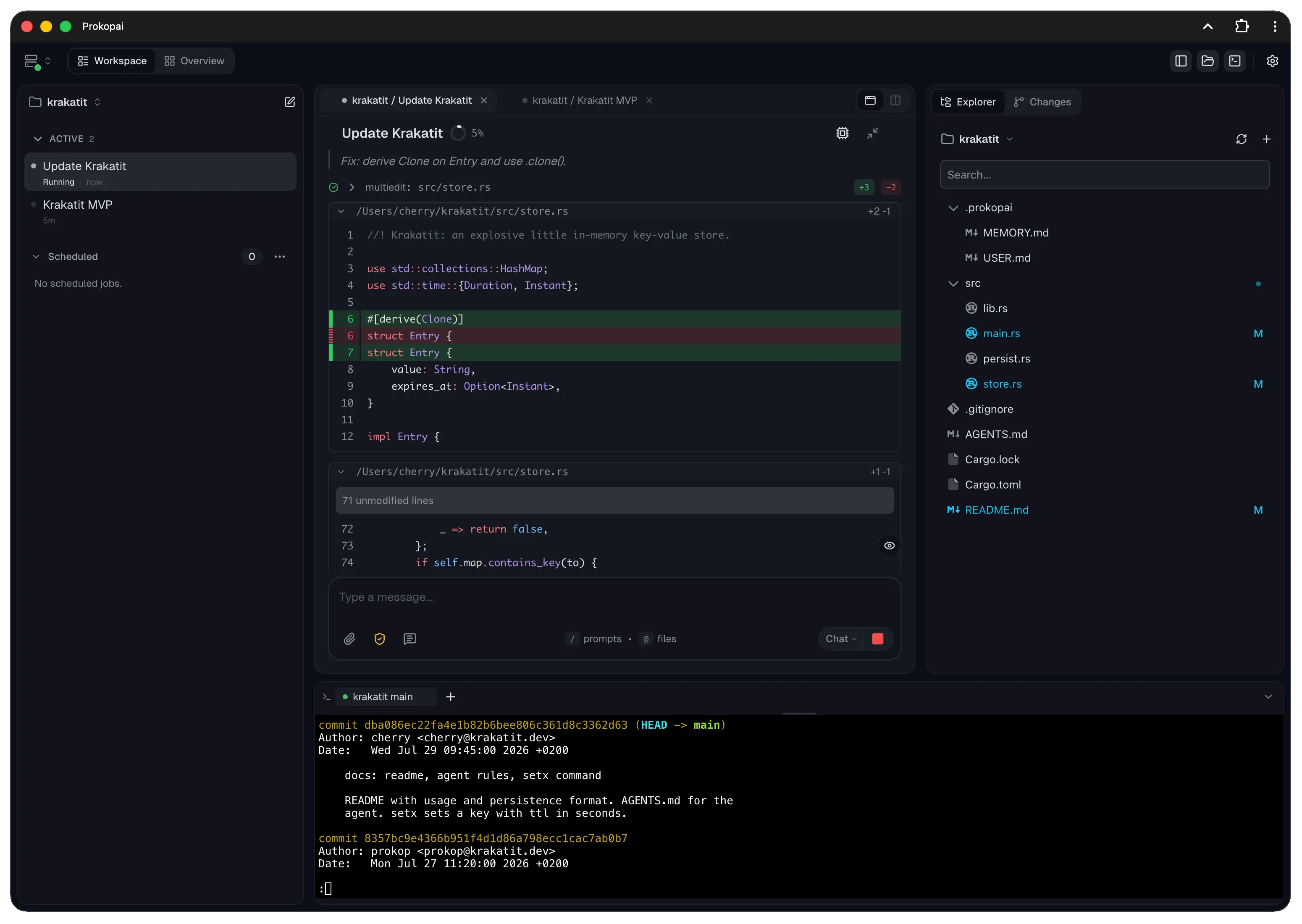
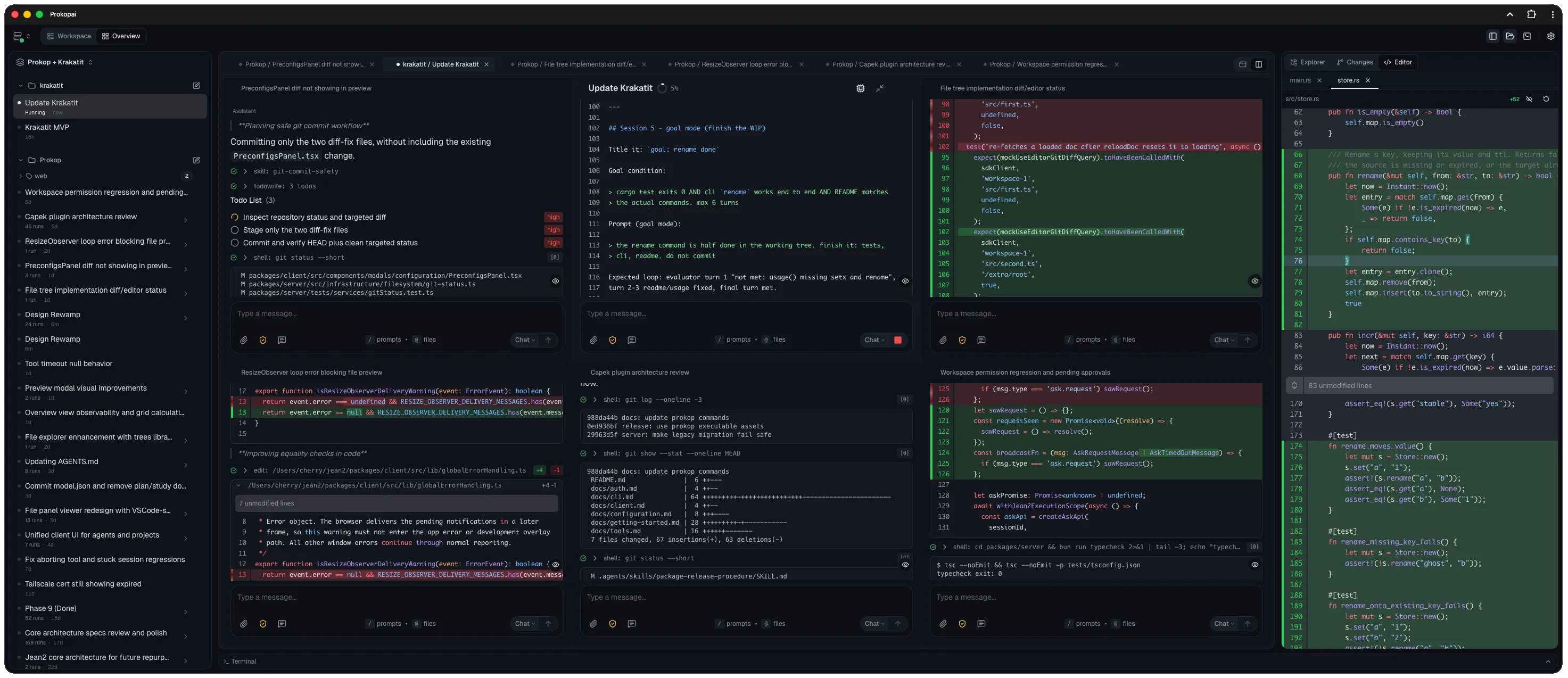
Sessions, projects, files, Git changes, terminals, and permissions in one focused interface. Any number of sessions running; the board keeps six live panes in view.
Board
Parallel sessions side by side. Six live panes, no window management.
Workspaces
Multiple projects with fast switching, plus an Overview that aggregates sessions across them.
Files and Git
Edit files, manage worktrees, create and switch branches. Browse commit history and diffs. Commit, pull (fast-forward), push, and rebase from the interface.
Terminals
Persistent terminals for long tasks. Keep talking while commands run.
Permissions
Every tool call visible. Approve one action, the session, or the workspace.
Schedules
Run recurring agent tasks with your own prompt and timing.
your setup
Start simple. Add what you need.
One project and one agent is a valid setup. Add memory, skills, or parallel sessions when they're useful to your work.
01 / one task
One project. One agent. One task.
Read, edit, search files, and run commands. Focus on the task in front of you. You don't need memory, skills, or a multi-agent setup to get useful work done.
- single workspace
- built-in coding tools
- one focused session
02 / persistent context
The agent starts to know you.
Turn on automatic learning to preserve useful lessons from conversations. Memory survives sessions, skills capture repeatable work, and session search brings past decisions back into reach.
- memory on
- skills on
- session search on
- automatic learning on
03 / parallel work
Keep separate tasks in separate sessions.
Session panel, six live sessions on the board, files alongside. Multiple workspaces under one Overview. Persistent agents with their own homes and memories, any number of sessions running, long tasks in background terminals while you keep working.
- board: six live panes
- multi-workspace overview
- persistent agents
- background terminals
Prokop Browser · Chrome extension
Your agent. Your browser.
Bring browser tabs into the same workflow as your code. The extension connects Chrome to your Prokop server so your agent can read pages and interact with them.
Read
Bring visible page content into the conversation.
Navigate
Open pages and manage browser tabs.
Interact
Click, type, select, and scroll on pages.
Requires a running Prokop server, a connected extension, and the corresponding browser tools enabled for your agent. Chrome restricts extension access to some pages.
on your phone
Not a Telegram bot. Your actual workspace.
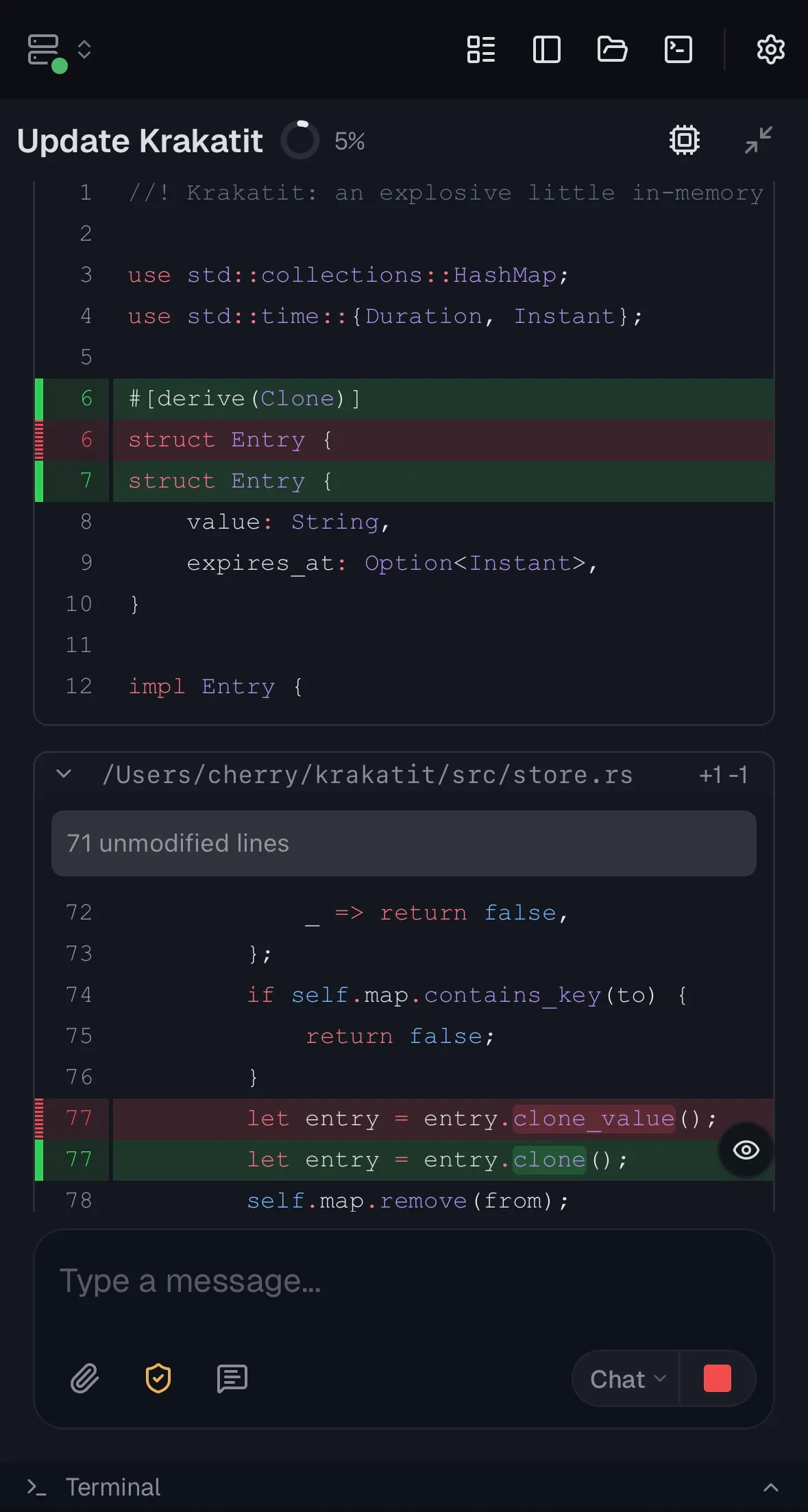
The client is a mobile-optimized PWA served by Prokop itself. Same sessions, same agents, same history, same permissions. Mobile reorganizes the interface into one surface at a time. It does not reduce the product to a chat bridge.
- The same agents and their memory, from anywhere
- Approve permission requests from your phone
- Push notifications when long runs finish
- Reach it privately through networking you choose, like Tailscale
Prokop ships the PWA, auth, and optional TLS. The network is yours.
in control
Familiar does not mean opaque.
Every tool execution is visible. Diffs land in the interface. Permission requests show the action, the risk, the resource, and the intent before you grant anything.
Scopes you can revoke. Auto-approval boundaries you set per session or workspace.
Edits arrive as diffs. Files, memory, and prompts stay inspectable.
yours
The working relationship stays yours.
The full stack is open source, Apache 2.0. Server and client. It runs as a daemon on your machine, independent of the browser or terminal. No account, no telemetry, no cloud gate between you and your workspace.
Open all the way through
Not open-core. The server, the client, the tools, the scheduler. Apache 2.0.
Files, not a database mystery
Memory, skills, and prompts are plain files on your disk. Version them, share them, delete them.
Bring your own provider
Connect supported providers or use Codex subscription authentication. Choose from the models available in Prokop.
Extensible by design
MCP tools over stdio or OAuth, browser automation, git worktrees. Tools appear alongside the built-ins.
model availability depends on the integration and prokop's supported configuration
questions
Straight answers.
Where does my data live?
On your machine. The server keeps its data and SQLite database under ~/.prokopai, and each project keeps its memory and skills as plain files inside the project directory. Nothing is uploaded to us. There is no us.
Does Prokop send telemetry?
No telemetry, no analytics, no account. Network traffic is what you set up: the model providers you connect, MCP tools you install, and the daemon serving the client on your machine.
Which model providers can I use?
Direct support includes OpenAI, OpenRouter, DeepSeek, MiniMax, Zhipu, and Zhipu Coding, plus Codex subscription authentication. Models from other companies can be reached through OpenRouter. Prokop does not add direct Anthropic or Google integrations of its own.
How is Prokop different from a CLI coding agent?
It is not a different agent. It is the workspace around one. Keep the model you already use and trade the terminal farm for a board of live sessions, files and diffs, persistent memory, session search, permissions, and the same interface on your phone.
What does Prokop cost?
Nothing. The full stack, server and client, is Apache 2.0. You pay your model provider for whatever you use. No seats, no tiers, no feature gates.
Can I actually work from my phone?
Yes. The client is a mobile-optimized PWA served by your daemon: the same sessions, agents, history, and permission approvals, reorganized for one surface at a time. You reach it over a network you control, such as Tailscale. Prokop ships the workspace, not the network.
Who builds and maintains Prokop?
One developer, Daniel Bilek. It is an active, evolving project rather than a hardened enterprise product, and the code is Apache 2.0, so it stays yours no matter what.
install
Bring your next project into Prokop.
One command, then prokop init. The daemon starts, the client opens, you pick a model and start working. Everything else is opt-in.